


Insights
Protective coatings key for profitable and sustainable wind energy
Okwaikumi na ibiri 11, 2025
5 mins read
The Global Wind Energy Council (GWEC), which includes the International Energy Agency (IEA) among its many members, published its latest report in June this year. According to the report the global offshore wind market has been growing by 10% on average each year over the past decade, with total installations of 83.2GW at the end of 2024. A further 56GW capacity was contracted in 2024 and, In the near term, GWEC Market Intelligence forecasts annual offshore wind capacity installations to grow from 8GW in 2024 to 34GW in 2030, representing a 325% increase by end of the decade.
However, some challenges are clear for the industry and the global society.
"One of the big challenges are the materials, the end of life and recycling," says Jan Buttle-Ulvin, EVP Renewables at Norwegian Energy Partners.
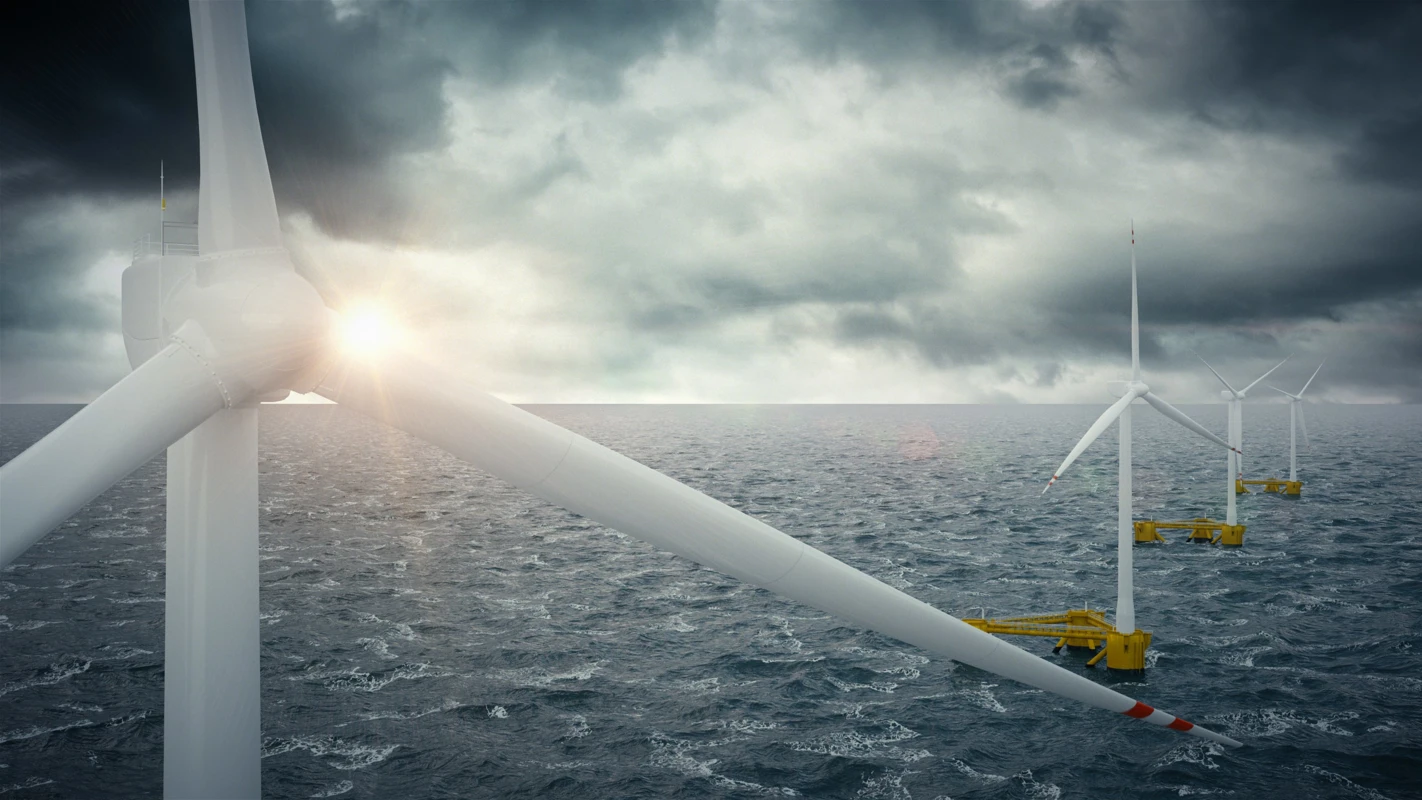
Indeed, the sheer volume of materials used in offshore wind farms is huge. Steel, composites, copper, rare earth metals and more. But in sheer volume terms, the main material is steel. The amount of steel used currently is around 220 tons per MW for each offshore 15 MW wind turbine with a state-of-the-art monopile, as per Boston Consulting Group’s white paper “the Winds of Change In Green Steel”. For floating wind the number could be even higher, and the quantity of steel required reaches staggering proportions for offshore wind in general.
"Across all uses, including offshore wind, steel production accounts for approximately 8% of global CO₂ emissions, of which approximately a third of that is used to replace corroded steel. Protecting these materials from degradation is one of the most important measures that can be taken, and it has a strong impact on global emissions. This is where protective coatings play a significant role , and if you can’t have corrosion protection that protects the foundation for 45 years without maintenance, there will be no wind farm. This is how much of an impact coatings can have on the profitability of a project,” says Anders Skilbred, Global Sustainability Manager at Jotun.

Focussed on own and client sustainability
For its part Jotun is taking a holistic approach to sustainability. "Sustainability is our top priority," says Skilbred. "We focus on our own emissions, through scope 1, 2, and 3, and also on the impact of our products across industries."
He emphasises that scope 3 emissions, which include all indirect emissions across the value chain, are notoriously difficult to manage. "About 65-75% of our total emissions come from raw materials used in our paints. We work closely with suppliers to reduce this. If they use renewable energy, it helps us reduce our footprint too. " Jotun is also investing in new technologies like bio-based binders for low-carbon solutions. "However, we do not want to sacrifice performance of products where that is crucial," Skilbred says.
As well as looking at its own sustainable practices, Jotun provides products and solutions that play a major role in solving problems for many industries. With the offshore wind sector an obvious candidate for that assistance. "The coatings that protect offshore wind assets for decades have a much larger positive impact than their carbon footprint – and that is reason enough for us to go into an industry like this”, says Skilbred.
According to the IEA steel production is energy intensive and around 1.85 tonnes of CO₂ is emitted for each tonne of steel made. Reducing the corrosion allowance of offshore turbines by just 1mm will save 50 tonnes of steel for the typical tower. For the expected number of turbines needed by 2030 that could equates to something in excess of 1,500,000 tonnes of steel saved.
From oil to wind: Leveraging legacy expertise
Jotun’s legacy and experience in the offshore oil and gas industry are proving invaluable in the wind sector. "We’ve been protecting oil and gas assets for over fifty years. Now we bring that experience into offshore wind. The conditions are similar, and we know how to handle them," says Skilbred.
But the scale is vastly different. "In oil and gas, you might have five installations. In offshore wind, you can look at a few hundred turbines across multiple farms," Buttle-Ulvin notes. "Maintenance strategies must adapt." That comment highlights an issue that is often not realised. Offshore wind farms are usually mentioned only in terms of GW capacity. At an average capacity of 10 MW per turbine it would take 100 turbines to produce just 1 GW. The number may be reduced a little by use of larger turbines, but a good example of current technology is the Dogger Bank farm in the UK where the intended capacity of 3.6 GW requires 277 turbines rated at 13 MW each.
Whatever the size of a particular offshore wind farm, the production phase, including the application phase, is something Jotun has spent time on to adapt to ensuring that the application of the coatings now is not seen as a bottle neck, but rather that the speed of this phase can contribute positively and represent an opportunity for fabricators – making it possible to produce at an even higher speed.
Further, choosing the right coating for a wind turbine is a science in itself. "The splash zone is particularly aggressive and nearly impossible to maintain over the assets lifetime," says Skilbred. "Further up, UV light, salt, and wind degrade the tower. The blades face wind and rain erosion, especially at the leading edge."
Scott Kim, Global Solutions Manager with focus on Wind Energy says: “Jotun’s recommended approach is to use glass flake reinforced polyester (GFRP) coatings for foundations, such as its own Baltoflake Ecolife coatings. These are designed to endure harsh conditions, delivering longevity and minimising the need of maintenance or even making it maintenance free – as well as ensuring reliable operations, a critical factor in the profitability of offshore wind projects.”
Also, the mass production nature of offshore wind demands efficiency and speed.
At the same time, understanding the difference – and the balance - between capital expenditure (Capex) and operational expenditure (Opex) for this industry is crucial to be able to be competitive. "Offshore wind projects are Capex-heavy," Buttle-Ulvin says. "You need coatings and materials that perform over decades without regular intervention to reduce the Opex to a minimal level."
Doing just that ensures that wind farms can operate consistently and produce the several benefits that they promise. Benefits such as a clean and renewable energy source that, as well as providing electric energy direct into grids, also add the extra energy needed for the production and scaling of other new cleaner energy sources such as hydrogen and power-to-X fuels which help in decarbonising other energy intensive sectors.

Jotun’s view is that adopting an “maintenance free” approach will extend the lifespan of assets, reducing replacement and the emissions that go with that. Also, protective coatings with proven performance ensure reliable operations and limits the need for unpredicted downtime, especially related to the foundation, which is almost impossible to do maintenance on.

Scott Kim
Global Solutions Manager at Jotun
Jotun’s view is that adopting an “maintenance free” approach will extend the lifespan of assets, reducing replacement and the emissions that go with that. Also, protective coatings with proven performance ensure reliable operations and limits the need for unpredicted downtime, especially related to the foundation, which is almost impossible to do maintenance on.
Scott Kim
Global Solutions Manager at Jotun
"Jotun’s view is that adopting an “maintenance free” approach will extend the lifespan of assets, reducing replacement and the emissions that go with that. Also, protective coatings with proven performance ensure reliable operations and limits the need for unpredicted downtime, especially related to the foundation, which is almost impossible to do maintenance on,” says Scott Kim.
As offshore wind continues to expand, the industry must prioritize sustainability at every level from materials and emissions to maintenance and collaboration. Companies like Jotun are leading the way, proving that with the right expertise and commitment, offshore wind can be both profitable and sustainable.
"We have the knowledge, resources and solutions," says Anders Skilbred, "and we are ready and willing to put them into good use for the greater benefit."
Sign up for newsletter from Jotun Insider and get the latest updates
The latest news and insights from Jotun
Browse more news and insightsJotun joins EOLMED floating wind project in France
Jotun announces the latest edition to its fire protection range: Jotachar 1709 XT
Contact us
Do you want to know more about our products and how we can help you? Leave your contact details here and we’ll get in touch.